
Paperman (2012) Review: Why This Disney Short Feels Like a Modern Classic
Few animated shorts earn the word "magical" without feeling like they're trying too hard. Released in 2012 and paired theatrically with Wreck-It Ralph, Paperman manages it effortlessly. The six-minute film sits at a fascinating moment in Disney's creative resurgence, arriving between the critical warmth of Tangled and the phenomenon of Frozen. This review looks at what makes it work: a premise stripped to its essentials, an emotional pull that needs no dialogue, and a visual technique that quietly changed how people thought about animated storytelling.
A Simple Premise With Real Emotional Lift
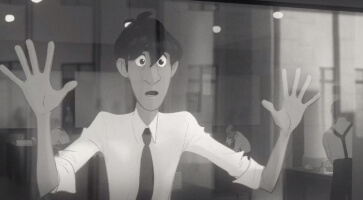
A young office clerk in New York City in the 1940s, he is trapped in a monotonous job that involves a lot of paperwork and commutes whose monotony is broken only by the sight of graffiti-covered train platforms on which he stands. That gust of wind shows up: and suddenly into his face, a drifted paper. And for the briefest moment, he looks across and into the face of a woman whom he's pretty sure he will never see again. She disappears into a leaving train. All he has is her lipstick kiss on crumpled stationery.
The result is mildly desperate and sweet. To attract her attention for a second, George folds his papers into kites and from his open office window on the other side of the street, out races one after another to fall down, dejectedly, following her as best he can. It shouldn't work as a story. It contains practically no dialogue; no emotional backstory, material enough to properly embody the very basicity of two people divided by so much glass and distance.
Why the Film's Visual Style Feels So Special
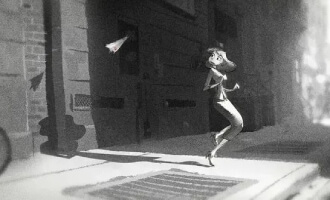
At the heart of what makes this short movie so visually arresting is a technique Disney called Meander - a proprietary system that layers hand-drawn 2D linework directly over CG-rendered geometry. The result sits somewhere between a classic studio cartoon and a polished modern production, and it works beautifully.
Black and white dominates every frame, giving the 1940s New York setting a crisp, almost cinematic stillness. Against that monochrome backdrop, the red lipstick mark on George's cheek and the matching red of Meg's dress carry enormous weight. Those two small pops of color do more emotional work than a dozen lines of dialogue ever could.
Character movement carries a softness that pure CG rarely achieves on its own. Limbs follow through, expressions linger, and the paper airplanes themselves move with a slightly exaggerated grace that feels magical rather than mechanical. There's no denying the animators made deliberate choices to keep things loose and warm.
The cityscape, all clean angles and geometric simplicity, keeps the focus squarely on the characters without feeling sparse. Every visual decision - the palette, the texture, the movement - quietly reinforces the film's romantic dreaminess rather than competing with it.
Its Lasting Charm Makes It Easy to Revisit
At seven minutes plus a few seconds, Paperman is an absolute treasure. There is no unnecessary setup nor narrative flab-the story builds subtly from a chance encounter at that breezy railway platform into a truly joyous conclusion, and it works with remarkable emotional clarity that usually eludes many features.
There are critics who might say that this sentimentality is too easy-which is a fair point-but in the end, it does not really matter. The story does not pretend to savory pockets of shadow; it is the purity that makes the whole project work, making this story possible with Director John Kahrs's and his very sincere commitment to it.
The truth in the hearts of those who already loved it-and the Academy of Motion Picture Arts and Sciences-proved that this was not a trivial film; it landed on a segment area during a great redefining period for Disney when Paperman ushered in and confirmed the fact that warmth needs not necessarily be separated from craftsmanship.
Upon going over it again, the great short stands well and free. The Meander rendering technique still looks unlike anything else, the character moment reads straight and square into pure pantomime, and that final rooftop sequence absolutely carries the same quiet thrill as it always has. It's a minor masterpiece of visual storytelling-compact, sincere and truly unforgettable.